










Which Instax should you choose? The complete guide to the 2026 range, new and used
mini 12, mini 13, mini 41, mini 99, Evo hybrids, SQUARE SQ40, WIDE 400: the right Instax for the format, settings, power source and film cost, plus the used models worth considering.
Buying guide · Instant · Updated October 2026
mini, SQUARE or WIDE, analog or hybrid, new or used: the Instax range now includes about a dozen cameras and just as many pitfalls. Here is how to choose the right one based on what you really want to photograph, model by model, with specifications verified by Fujifilm.
Fujifilm launched its first Instax mini in Japan in November 1998, followed by the large-format Instax 100 (the future WIDE) in 1999. Twenty-five years later, Instax has become the most popular instant film system in the world, far ahead of Polaroid. The downside of this success is a cluttered range: €90 cameras that do everything automatically, "expert" models with special effects, hybrid digital cameras that print, and three film formats that are incompatible with each other. This guide starts with how you plan to use it (parties, travel, portraits, gifts, creativity) and leads you to the right model, explaining what really matters each time: the format, the exposure mode, the power source, the minimum distance, and the actual cost of the film.
The essentials in 30 seconds
- The default choice: mini 12 or mini 13 (2026, adds a self-timer). Everything is automatic, and the film is the cheapest per photo.
- The most creative analog option: mini 99, with its six color effects, double exposure, and B exposure.
- For large photos and groups: WIDE 400, with a format twice as wide as the mini.
- To avoid wasting film: a hybrid (mini Evo, mini Evo 2 in late 2026, WIDE Evo): you choose before printing.
- Pitfall no. 1: buying the wrong film. mini, SQUARE, and WIDE are not interchangeable, and none are compatible with Polaroid.
First, choose the format
The film format determines everything: the size of your photos, the price of each shot, and the size of the camera. The three Instax films are all the same width (86 mm) but have different heights, and each camera only accepts one format.
| Format | Print size | Image area | What you need to know |
|---|---|---|---|
| instax mini | 86 × 54 mm | 62 × 46 mm | The size of a credit card; the best-selling format, with the widest choice of film |
| instax SQUARE | 86 × 72 mm | 62 × 62 mm | Square format, close to the Polaroid spirit; fewer models |
| instax WIDE | 86 × 108 mm | 62 × 99 mm | Image twice as wide as the mini; ideal for groups and landscapes |
The mini is a pocket format: perfect for a portrait, a selfie, or a close-up of an object, but tighter for a landscape. The SQUARE provides a balanced frame, more like an "artistic photo." The WIDE is the only one that truly captures a scene, but the camera weighs about 600 g and the film costs more per shot. To compare the three in detail, with framing examples, read Instax mini, SQUARE or WIDE: what are the differences.


The criteria that really matter
Analog or hybrid?
An Instax analog camera exposes the film directly: every press of the shutter costs you a photo, whether it turns out well or not. That is the magic of instant photography, with all its surprises. A hybrid (mini Evo, mini Evo 2, mini Evo Cinema, mini LiPlay, WIDE Evo) is a small digital camera with a printer: you take the photo, view it on the screen, add an effect, and only print the best ones. The film lasts longer, you can print from your smartphone, but the print reproduces a digital file: the result is sharper and more consistent, less "accidental."
Automatic exposure or manual settings?
The older mini 8 and mini 9 required turning a brightness dial according to the lit indicator: many ruined photos were caused by this. Since the mini 11 (2020), entry-level models measure the light and automatically set the shutter speed (from 1/2 to 1/250 s on the mini 12). The mini 99 retains the automatic mode but adds exposure compensation, indoor and sports modes, double exposure, and B exposure.
Minimum distance and selfies
With a 60 mm f/12.7 lens and a parallax viewfinder, an Instax mini sees things a little differently than you do. In close-up mode, the mini 12 corrects this offset (parallax) from 0.3 to 0.5 m: this is what makes selfies and close-ups of objects successful. The WIDE 400, on the other hand, only focuses from 0.9 m without its included close-up lens (40 to 50 cm with it).
Power source
Three options: standard AA batteries (mini 12, mini 41, WIDE 400; the mini 13 also accepts rechargeable NiMH AA batteries), more expensive CR2 lithium batteries (SQUARE SQ40 and older SQ1, SQ6), or a rechargeable battery (mini 99, hybrids). When traveling, AA batteries can be found everywhere; a proprietary battery requires its own charger.
Expert tip
Instax film is 800 ISO: it is very forgiving, but it hates backlighting and very bright backgrounds. Place the light behind you or to the side, and get closer to your subject: at 1 m, the flash illuminates well; beyond 2 to 2.7 m, depending on the model, it is no longer useful.
The 2026 range, model by model
Here are the Instax cameras for sale at Fujifilm in October 2026, with what truly sets them apart. The specifications come from the official product sheets; we only list a price when it is an announced and dated recommended retail price from Fujifilm.
Instax mini 12: the simplest
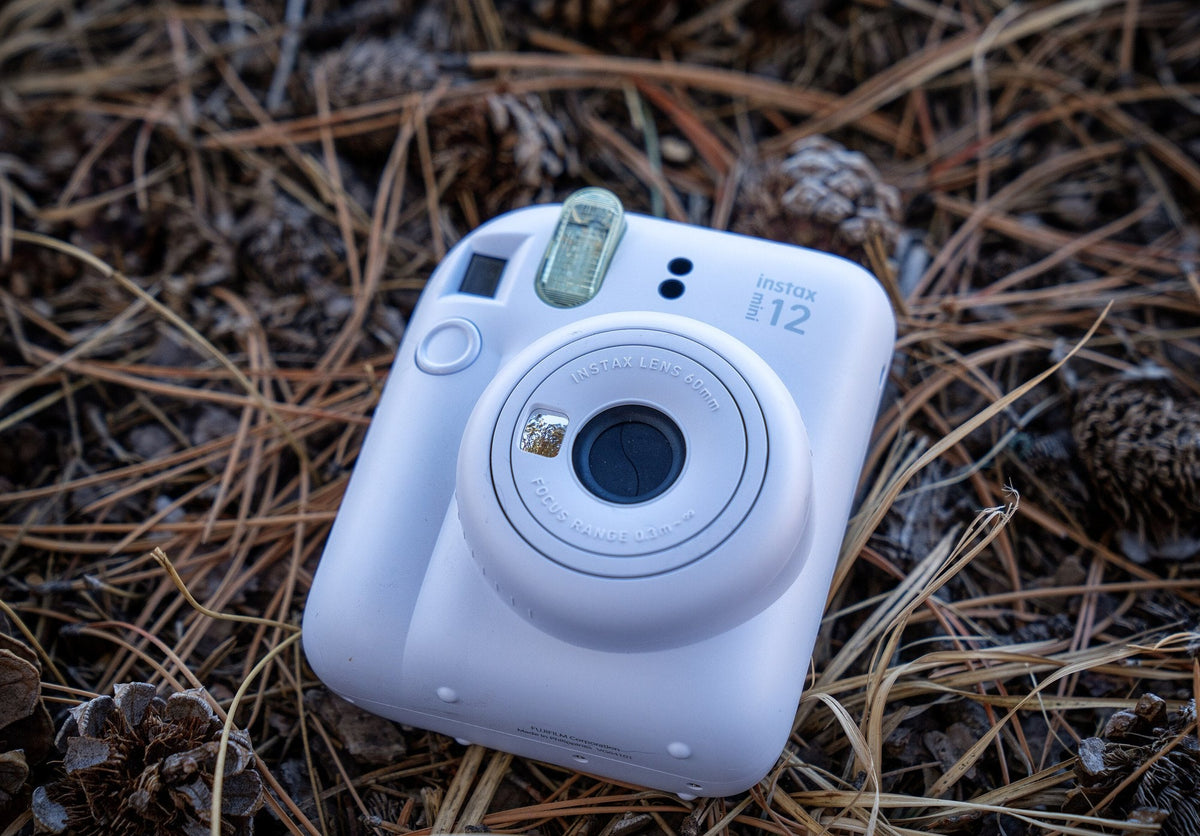
Released in March 2023, the mini 12 is the camera we recommend by default. You turn the lens to turn it on, and again to switch to close-up mode; exposure and the flash (which fires with every shot at an adjusted power) are automatic. Shutter speed from 1/2 to 1/250 s, two AA batteries for about ten cartridges of ten shots each, 306 g. Its only real limitation: no creative control. Read our full review of the Instax mini 12.

Instax mini 13: the mini 12 with a self-timer
Announced by Fujifilm on March 17, 2026, and available in France since June 25, 2026, at the recommended price of €89.99, the mini 13 includes everything from the mini 12 (automatic exposure, close-up with parallax correction, selfie mirror) and adds what was missing: a 2- or 10-second self-timer (327 g according to the product sheet), with a small included stand to tilt the camera. For group photos where you want to be included, it is now the best entry-level choice.
Instax mini 41: the retro look
Introduced in April 2025, the mini 41 succeeds the mini 40 with the same black, film-camera-style design. It works like the mini 12 (automatic exposure, close-up, AA batteries), but in a heavier (345 g according to the product sheets) and more substantial body. You buy it as much for the object itself as for the photos. Read our review of the mini 41.

Instax mini 99: the only new "expert" mini
Launched in 2024, the mini 99 is the most comprehensive analog Instax. It offers three focus zones (0.3 to 0.6 m, 0.6 to 3 m, 3 m to infinity), a shutter speed from 1.8 s to 1/400 s, B exposure up to 10 seconds, exposure compensation, double exposure, and six color effects produced by internal LEDs (including "Light Leak" and sepia), plus a vignetting switch. It runs on an NP-70S battery (about ten cartridges per charge) and has a tripod mount. It is the choice for those who want to decide how their image looks. Read our review of the mini 99.
The best Instax is not the most expensive: it is the one whose format you accept, and therefore the price of each photo.
The Vibes Photo editorial team
Instax mini Evo and mini Evo 2: the benchmark hybrid
The mini Evo (2021) combines a digital sensor, a screen, and a mini printer. Its ten lens effects and ten film effects provide one hundred combinations, selected with dials. It also prints photos from your phone. Fujifilm announced its successor, the mini Evo 2, on October 26, 2026, expected in late November 2026 at the recommended price of €269.99 in France: a 4.5-inch touchscreen, expanded framing ("Expanded View"), 600 dpi printing in "Rich" or "Natural" mode, and an "Immersive Movie" function that records the four seconds preceding each photo on a microSD card. Read our review of the mini Evo.
To be verified
The mini Evo 2 is not yet in stores as of the update date of this guide: the specifications mentioned are those from Fujifilm's press release. If you are hesitating with the mini Evo, wait for the first independent reviews, and check that the mini Evo remains available (and at what price) after the release.
Instax mini Evo Cinema: video as well
Released in Japan in late January 2026, the mini Evo Cinema records 15-second clips (30 seconds via the app), offers ten effects inspired by different eras, and prints prints with a QR code that links to the video. Interesting for parties and travel memories; less so for those looking for a real photographic image.
Instax mini LiPlay and LiPlay+: the smallest
The LiPlay (2019) is a very compact hybrid that can add sound to the photo via a printed QR code. The LiPlay+, announced in October 2025, adds a front camera for selfies. It is a good choice for a teenager who also wants to print photos from their phone.


Instax SQUARE SQ40: the simple square
Released in June 2023, the SQ40 is now the main analog camera in SQUARE format. Automatic exposure, selfie mode from 0.3 m (0.5 m in normal mode), retro look close to the mini 40. It runs on two CR2 batteries, more expensive and less common than AA. Read our review of the SQ40.

Instax WIDE 400: the large format
Launched in June 2024, the WIDE 400 is the camera for weddings, family gatherings and landscapes. Automatic exposure, four AA batteries, close-up lens included for 40 to 50 cm. It weighs about 616 g and requires a bag. Read our review of the WIDE 400.
Instax WIDE Evo: the large format hybrid
Launched in February 2025, the WIDE Evo applies the mini Evo recipe to the WIDE format: 3.5-inch screen, wide-angle mode, ten adjustable lens effects and ten film effects, printing from the smartphone. It is the most versatile camera in the range, and the bulkiest.

The summary table
| Model | Format | Type | Main feature | Power |
|---|---|---|---|---|
| mini 12 (2023) | mini | Analog | Total simplicity, close-up | 2 AA batteries |
| mini 13 (2026) | mini | Analog | 2 or 10 s self-timer | 2 AA batteries (or NiMH) |
| mini 41 (2025) | mini | Analog | Retro look | 2 AA batteries |
| mini 99 (2024) | mini | Analog | Effects, double exposure, B exposure | NP-70S battery |
| mini Evo / Evo 2 | mini | Hybrid | 100 effect combinations, sorting before printing | Built-in battery |
| mini Evo Cinema (2026) | mini | Hybrid | 15 s video clips | Built-in battery |
| mini LiPlay / LiPlay+ | mini | Hybrid | Very compact, sound, selfie (LiPlay+) | Built-in battery |
| SQUARE SQ40 (2023) | SQUARE | Analog | Automatic square format | 2 CR2 batteries |
| WIDE 400 (2024) | WIDE | Analog | Large format, groups | 4 AA batteries |
| WIDE Evo (2025) | WIDE | Hybrid | Large format and effects | Built-in battery |
Second-hand Instax worth buying
Instax cameras are sold second-hand a lot, often after a few cartridges. They are simple and robust, but age shows on the battery compartments and rollers. Here are the models that retain real interest.
mini 8 and mini 9
The most common (2012 and 2017). Fixed speed of 1/60 s and five brightness settings to choose yourself according to the indicator: reserved for those who accept to learn.
mini 11
The successor of the mini 9 (2020), first of the entry-level range with automatic exposure, with selfie mode. The best simplicity/price ratio on the second-hand market.
mini 90 Neo Classic
The favorite of enthusiasts since 2013: 1/8 to 1/400 s, double exposure, B exposure, macro mode. Specific NP-45A battery to check.
Wide 300, SQ6 and SQ1
The Wide 300 (2014, about 612 g) remains the most common WIDE second-hand. The SQUARE SQ6 (2018) and SQ1 (2020) run with two CR2 batteries.

Classic trap
A second-hand Instax "tested" without film proves nothing. The real test: insert a cartridge and check that the black protective sheet comes out at startup, then take a photo. If the camera was stored with batteries, open the compartment: green or white traces indicate a leak.
Which Instax for which profile
| Your profile | Our choice | Why |
|---|---|---|
| First instant photo, child, gift | mini 12 or mini 13 | Nothing to set, most affordable film |
| Selfies and group photos | mini 13 | Self-timer, mirror, corrected close-up |
| Vintage look, object to display | mini 41 | Retro styling, same simplicity |
| Photographer who wants settings | mini 99 | Effects, focus zones, B exposure |
| Do not waste film, print from phone | mini Evo (or Evo 2) | Sorting before printing |
| Wedding, family, landscapes | WIDE 400 | Image twice as wide |
| Square format at a low price | SQUARE SQ40 | Automatic, Polaroid spirit |
| Teenager who wants to do everything | mini LiPlay+ | Compact hybrid, selfie, sound |
For a child, our detailed advice is in which camera for a child; for a wedding party, look at the alternatives to disposable cameras for guests. And if you are still hesitating with Polaroid, our comparison Polaroid or Instax puts the two systems face to face.


Traps and checks before buying
A few mistakes come back again and again, new or second-hand. Avoiding them saves you lost cartridges.
- Check the film format written on the camera or its sheet: mini, SQUARE or WIDE. A mini film does not fit in a SQ40.
- Do not confuse with Polaroid: Polaroid films (i-Type, 600, SX-70, Go) do not go in any Instax, and vice versa.
- Plan the power: AA batteries, CR2 or battery; second-hand, ask if the charger is provided (mini 90, mini 99, hybrids).
- Test with a cartridge: the black sheet must come out, then each photo, without regular traces (dirty rollers).
- Inspect the battery compartment: no oxidation on the contacts.
- Look at the lens and the viewfinder: no deep scratches, no dust inside the lens.
- On a hybrid: check the screen, the battery charge, the connection to the application and the printing of a file.
If your Instax refuses to start or spits out blank photos, our Instax not working: solutions guide lists the causes. For the right steps from the first cartridge, read the Instax mini user guide.
Did you know?
Instax film takes about 90 seconds to develop, and this time varies with the temperature. There is no need to shake the photo: it doesn't speed anything up. In cold weather, slide it into an inner pocket while it develops.
The real budget: the camera and the film
The price of an Instax counts for less than that of the film. With ten shots per cartridge, an outing with friends quickly consumes two or three cartridges. The mini format is the cheapest to look at, the WIDE the most expensive, and the editions with a decorated frame cost more than white film. A hybrid reduces the bill: you only print what you keep. Conversely, a cheap second-hand analog camera can cost more to use than a new model if you miss a lot of shots with an old mini 8 with manual settings.
We do not publish specific film prices here, because they often change depending on the store and the packs. The detailed calculation of the cost per photo, Instax and Polaroid combined, is in how much an instant photo really costs. And so that your prints do not yellow, follow our guide to preserve instant photos.
Frequently asked questions
What is the best Instax for beginners?
The mini 12, or the mini 13 if you want a self-timer. Everything is automatic: you turn the lens to turn it on, you frame and you shoot. Mini film is the most common and the cheapest to look at.
What is the difference between the mini 12 and the mini 13?
The mini 13, released in France in June 2026, takes the automatic exposure, the close-up mode with parallax correction and the selfie mirror of the mini 12, and adds a 2 or 10 second self-timer with a stand to tilt the camera.
Are Instax mini, SQUARE and WIDE films compatible with each other?
No. The three films have the same width of 86 mm but different heights (54, 72 and 108 mm). Each camera only accepts its format. Polaroid films are not compatible with any Instax.
Analog or hybrid Instax: what to choose?
Analog if you want the surprise and the direct rendering of the film, and you accept to miss shots. Hybrid if you want to choose before printing, apply effects and print photos from your phone. The hybrid consumes less film.
Is the mini 99 worth its price compared to the mini 12?
Yes if you want to control your image: three focus zones, exposure correction, double exposure, B exposure up to 10 s and six color effects. No if you just want party memories: the mini 12 or the mini 13 do this job very well.
Should you wait for the Instax mini Evo 2?
If you want a hybrid and you are not in a hurry, waiting for the release planned for late November 2026 allows you to compare with the mini Evo, whose price may change. The announced features (4.5-inch touchscreen, mini-video "Immersive Movie") will only be confirmed in the first tests.
Is a second-hand Instax a good idea?
Yes, provided you test it with a cartridge and check the battery compartment. The mini 11 and the mini 90 are the best deals; the mini 8 and 9 require you to set the brightness yourself.
Vibes Photo
Find your instant camera
Discover our selection of instant cameras and ask us your questions before choosing.
Sources
- Fujifilm France, instax camera range (models on sale in October 2026).
- instax.com, mini 12 spec sheet (60 mm f/12.7 lens, 1/2 to 1/250 s, close-up 0.3–0.5 m, AA batteries, 306 g, 90 s development).
- Fujifilm France, mini 13 press release (March 17, 2026) (self-timer, availability on June 25, 2026, recommended price €89.99).
- Fujifilm, mini 41 press release (April 2025) (launch date).
- instax.com, mini 99 spec sheet (focus zones, 1.8 s to 1/400 s, B exposure, NP-70S, modes).
- Fujifilm North America, mini Evo 2 press release (October 26, 2026) (4.5-inch screen, Immersive Movie, release late November 2026).
- CNET France, mini Evo 2 (recommended price in France).
- Fujifilm, mini Evo Cinema press release (15 s video, effects).
- Fujifilm, mini LiPlay+ press release (October 2025) (date and selfie camera).
- instax.com, SQUARE SQ40 spec sheet (CR2 batteries, distances).
- instax.com, WIDE 400 spec sheet (AA batteries, close-up lens, distances).
- Fujifilm, WIDE Evo press release (February 2025) (launch and features).
- Wikipedia, list of Instax cameras (release dates of older models, speeds, power supply, weight).
Images: authors, licenses and sources indicated under each photo. Verifications carried out in October 2026.